


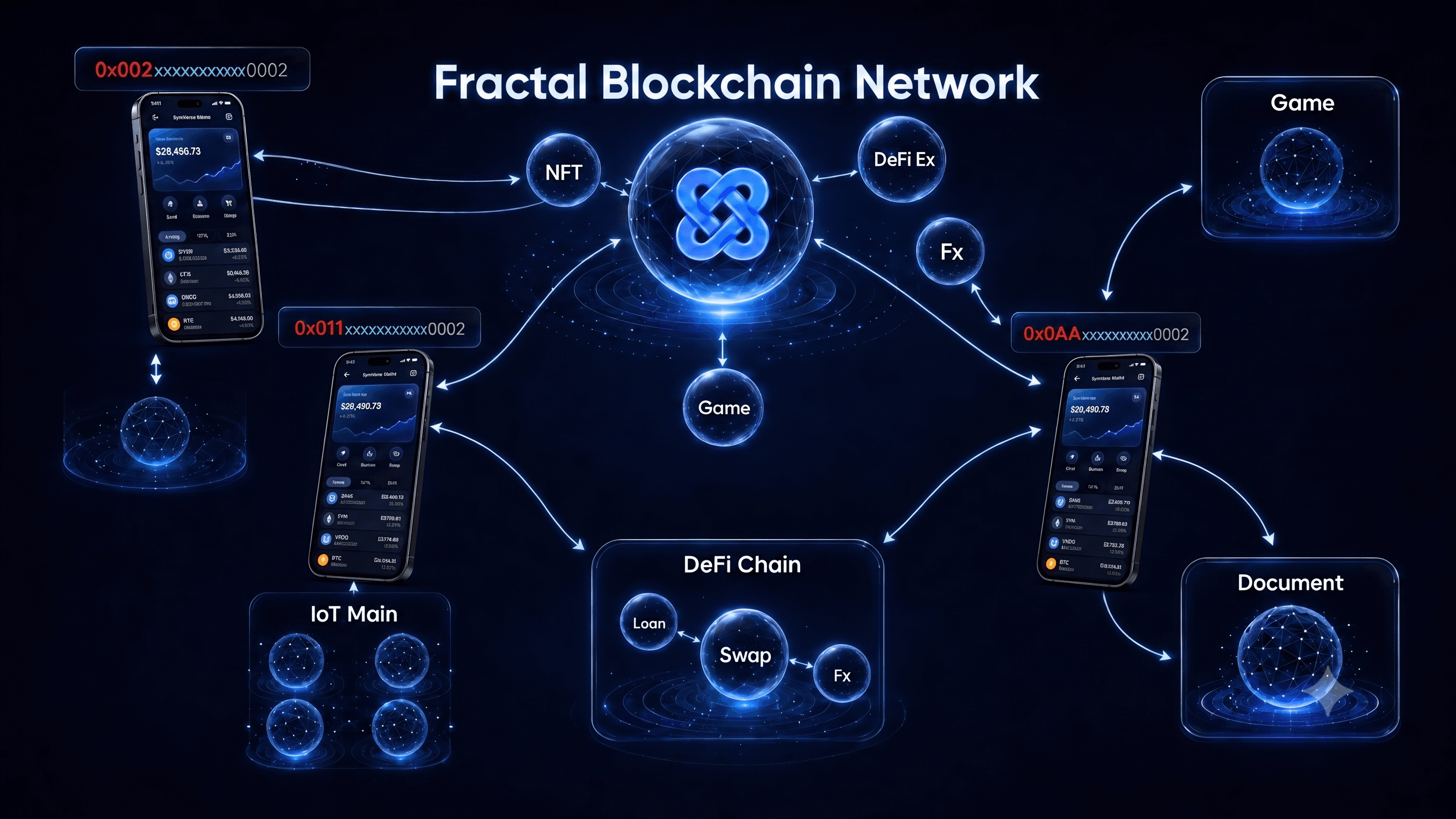
In the current Web3 environment, users are often required to use a separate wallet address for each blockchain.
They must manage chain-specific addresses, networks, and gas fees. Consequently, moving between services is often complex and inconvenient.
Within the Fractal Network, a SymID issued on one chain can be recognized and used by other chains that support it.
This can help transform Web3 from today’s complex, wallet-centric structure into a user-centric ecosystem built around a unified identity.
Existing blockchain architectures generally offer two main options.
The first is to build all services on a single public mainnet. The second is to create separate private or dedicated blockchains for each service or organization.
The first approach provides a high level of interoperability, but it may also face network congestion, high transaction fees, and performance limitations. The second approach offers greater performance and policy autonomy, but it can easily become isolated from other blockchain networks.
The Fractal Network is designed to provide both the independence of individual mainnets and network connectivity through a shared identity system. As a result, enterprises and institutions can retain full control over their own blockchain infrastructure while seamlessly connecting to the broader Web3 ecosystem.
When all transactions are processed on a single blockchain, performance may decline as the number of users and transactions increases. Since the Fractal Network can distribute services across multiple independent mainnets, it enables horizontal scalability.
For example, a global platform may be structured with:
Since each chain processes transactions independently, the total processing capacity of the network increases as additional chains are added.
Unlike simply increasing block size or improving transaction speed on a single blockchain, the Fractal Network separates blockchain services across multiple chains while enabling them to function as a unified service ecosystem through a shared identity system and oracle infrastructure. This architecture is particularly suitable for applications that require high-speed processing and service-level independence, including auctions, electronic voting, order matching, and securities trading.
With SymID usable across multiple chains, a single user can access and connect a wide range of Web3 services through one unified identity.
For example, a user may use the same SymID for:
Each service may operate on a separate and independent mainnet. From the user’s perspective, however, these services appear and function as a single, integrated Web3 ecosystem.
This means that the Fractal Network has the potential to evolve beyond a conventional blockchain network and become the foundational infrastructure for a Web3 super app or a Web3 operating system.
Within the Fractal Network, one of the most valuable assets may be not just fungible tokens or assets, but SymID itself.
Once a SymID is recognized across multiple chains, a wide range of information can accumulate around that identity, including:
When this information can be verified across different blockchains within a user-authorized scope, SymID becomes more than a simple login credential. It serves as the foundation for decentralized identity and reputation.
For example, trust, qualifications, or credentials established on one chain can be utilized in financial, transactional, or community services on another. This shift has a profound impact on Web3 credit assessment, DAO governance, decentralized finance, and digital citizenship models.
Rather than recording all personal information directly across multiple chains, the network supports selective disclosure mechanisms, enabling users to prove only the specific information required for a given purpose.
Enterprises and public-sector organizations are often reluctant to host all of their operational data on a single public blockchain.
Within the Fractal Network, each institution is empowered to operate its own independent mainnet and autonomously determine key operational policies, such as:
When necessary, institutions can also recognize SymIDs issued on other chains and connect their services with external blockchain ecosystems.
This allows enterprises to participate in Web3 without relinquishing control over their legacy systems and operational policies.
This model is exceptionally well-suited for sectors requiring strict data sovereignty, such as finance, healthcare, public administration, supply chains, and digital certification.
The current Web3 landscape is largely characterized by intense competition among blockchains for users, developers, and liquidity.
The Fractal Network introduces a collaborative model where multiple blockchains operate under a shared core platform and identity framework.
Each chain does not need to provide every function independently; instead, one chain can specialize in identity verification, another in transactions, and another in voting or asset issuance.
Under this model, each blockchain functions less like a standalone, general-purpose platform and more like a specialized, modular component within a broader network.
This ultimately paves the way for the Web3 ecosystem to evolve from a fragmented market dominated by isolated blockchains into a federated, cooperative architecture where specialized chains share responsibilities and thrive together.
In conventional multichain environments, tokens and data are typically transferred through blockchain bridges. Many bridges operate by locking assets on one chain and minting corresponding wrapped tokens on another, posing significant security vulnerabilities.
In the Fractal Network, the primary focus is not simply the transfer of assets, but the cross-registration and authorization of digital identities.
The central paradigm therefore changes as follows:
This distinction is crucial. Once user identities are securely interconnected, the network can seamlessly orchestrate not only assets, but also permissions, reputation, memberships, credentials, and governance participation records.